Better control before you publish
How reworked post creation, drafts, and review flows improve automated social media publishing.
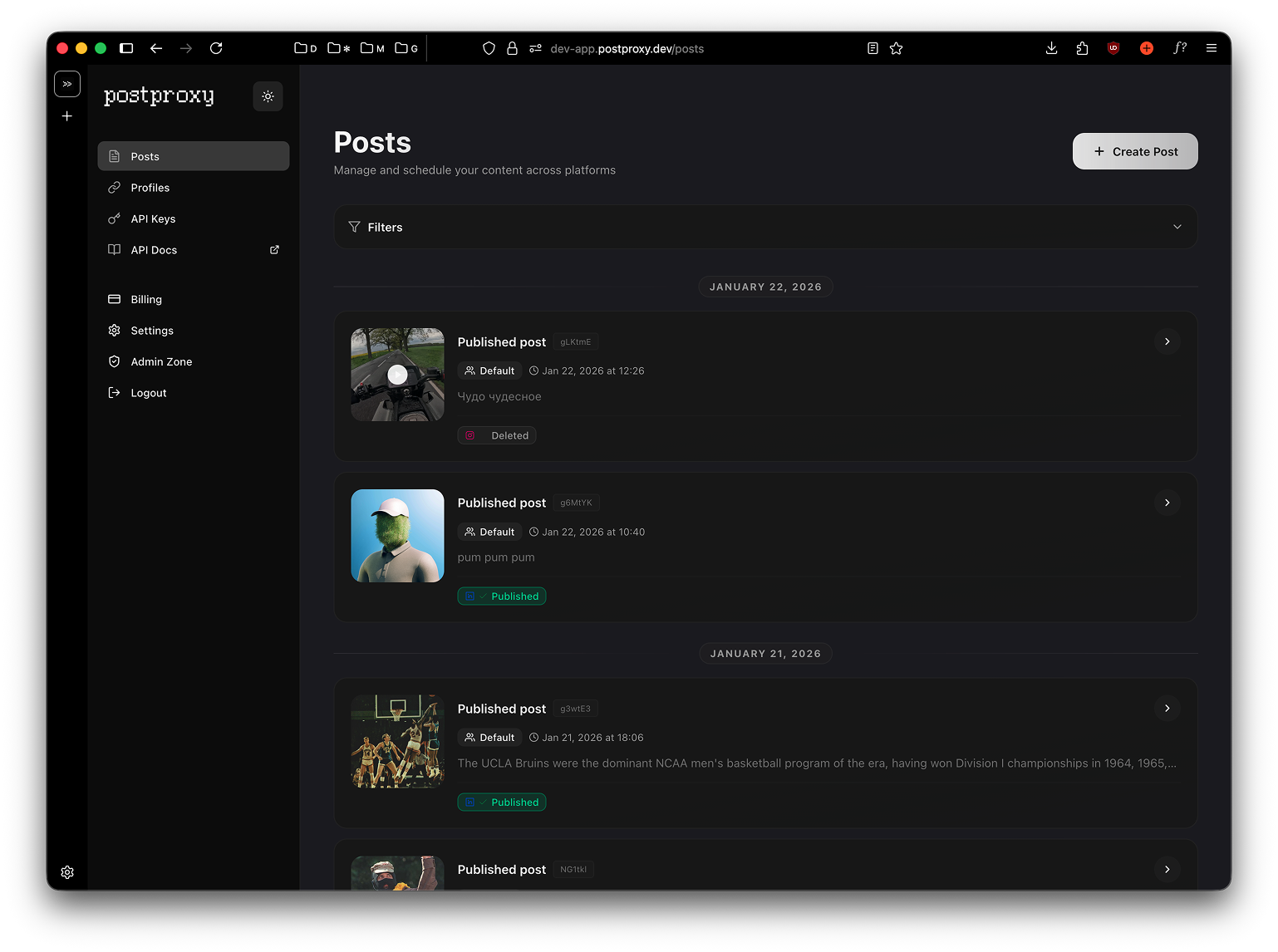
Publishing UX matters more than it looks
Publishing often feels like the simplest part of the workflow.
You write a post. You hit publish. You move on.
In practice, this is also where small UX issues quietly turn into friction, hesitation, and last-minute fixes. Especially once publishing is no longer a one-off action, but part of a recurring workflow.
That’s why we recently spent time reworking two closely related areas in Postproxy: post creation and draft handling.
Reworking post creation for real publishing workflows
The old post creation flow worked, but it was optimized for speed, not clarity.
As Postproxy started to be used more for automated and semi-automated publishing, a pattern emerged. People wanted to move quickly, but they also wanted confidence. They wanted to see what was going to be published, where, and in what state — without jumping between screens or guessing.
The updated post creation flow is designed around that reality.
It makes the structure of a post clearer. It reduces visual noise. It keeps the focus on the publishing intent instead of the interface itself. Creating a post now feels less like filling out a form and more like preparing an action that will be executed by the system.
This matters when publishing is part of a workflow, not just a manual task.
Why draft posts needed to exist explicitly
Before drafts were explicit, they still existed — just informally.
People would prepare a post and hesitate to publish. Or leave a tab open. Or save content somewhere else “just in case”. Drafts were already part of the mental model, but not part of the system.
That gap creates uncertainty.
Draft posts make that state explicit. A draft is now a first-class step in the publishing workflow. You can prepare content, review it later, and publish when you’re ready — without treating publishing as a one-way door.
This is especially important for automation-friendly setups, where preparation and execution don’t always happen at the same time.
Review before publish is not hesitation
Reviewing a post before publishing is often mistaken for friction.
In reality, it’s a control point.
The new review step gives you a clear snapshot of what will be published before it goes out. This doesn’t slow things down. It reduces the cost of mistakes. Instead of fixing things after the fact, you confirm intent upfront.
In automated or semi-automated social media publishing, this distinction matters. Review becomes a state in the workflow, not an interruption.
How these changes fit together
Reworked post creation, explicit drafts, and a clearer review step are not separate features.
They form a single flow:
- prepare a post
- keep it as a draft if needed
- review it with full context
- publish with confidence
That flow matches how people actually work, especially when publishing is one step in a larger system.
Better UX supports better automation
Good automation is not just about removing clicks. It’s about reducing uncertainty.
When publishing UX makes states explicit — draft, ready, reviewed, published — automation becomes easier to reason about. Humans know where they are in the process. Systems know what is allowed to happen next.
That shared understanding is what keeps workflows reliable.
Publishing should feel calm
The goal of these changes is not to make Postproxy more complex.
It’s the opposite.
Publishing should feel calm. Predictable. Boring in the best sense of the word. When the interface reflects the real states of the system, there’s less need for second-guessing and workarounds.
These updates move Postproxy a bit closer to that ideal: publishing UX that supports automation instead of getting in its way.
Postproxy
One API for every social platform
Publish to Instagram, X, LinkedIn, TikTok, YouTube and more with a single request. Free plan, no credit card required.