Making changes visible
Why we set up a public changelog, roadmap, and a place for feedback.
Changes already exist
Every product changes all the time.
Bugs get fixed. Limits move. Edge cases appear. Small decisions accumulate into behavior that users experience long before it is documented or announced. Even when nothing is said publicly, change is still happening.
The question is not whether a product changes.
The question is whether those changes are visible.
Silence is also a signal
When changes are not visible, users start guessing.
Was this intentional or a bug? Is this temporary or permanent? Is this something the product is moving toward, or something that will disappear next week? Silence forces people to build their own mental model, often based on fragments and assumptions.
That is rarely the model the product team intended.
For infrastructure products, this gap is especially painful. Systems are built on expectations. When expectations drift, trust erodes quietly.
Why we wanted changes to have a place
As Postproxy started to evolve, we realized that release notes in Slack messages, GitHub commits, or internal docs were not enough. We needed a single place where change could be observed over time.
Not marketing announcements.
Not launch posts.
Just a record of what moved.
A changelog is not about celebrating progress. It is about making behavior legible.
A roadmap as a conversation, not a promise
Public roadmaps are tricky. Treated as promises, they inevitably disappoint. Treated as marketing, they become noise.
We think of the roadmap differently. It is a snapshot of current intent. What we are exploring. What we are actively working on. What we are deliberately not doing right now.
That intent can change. Making it visible does not lock it in. It gives context.
For users building on top of Postproxy, that context matters more than certainty.
Feedback needs a surface
Feedback exists whether you collect it or not. It shows up in support messages, private chats, and offhand comments. Without a shared surface, it stays fragmented and hard to reason about.
We wanted a place where feedback could live next to decisions. Where feature requests, questions, and concerns are visible not just to us, but to other users as well.
This changes the dynamic. Feedback stops being a private exchange and becomes part of the product’s shape.
One place for all of it
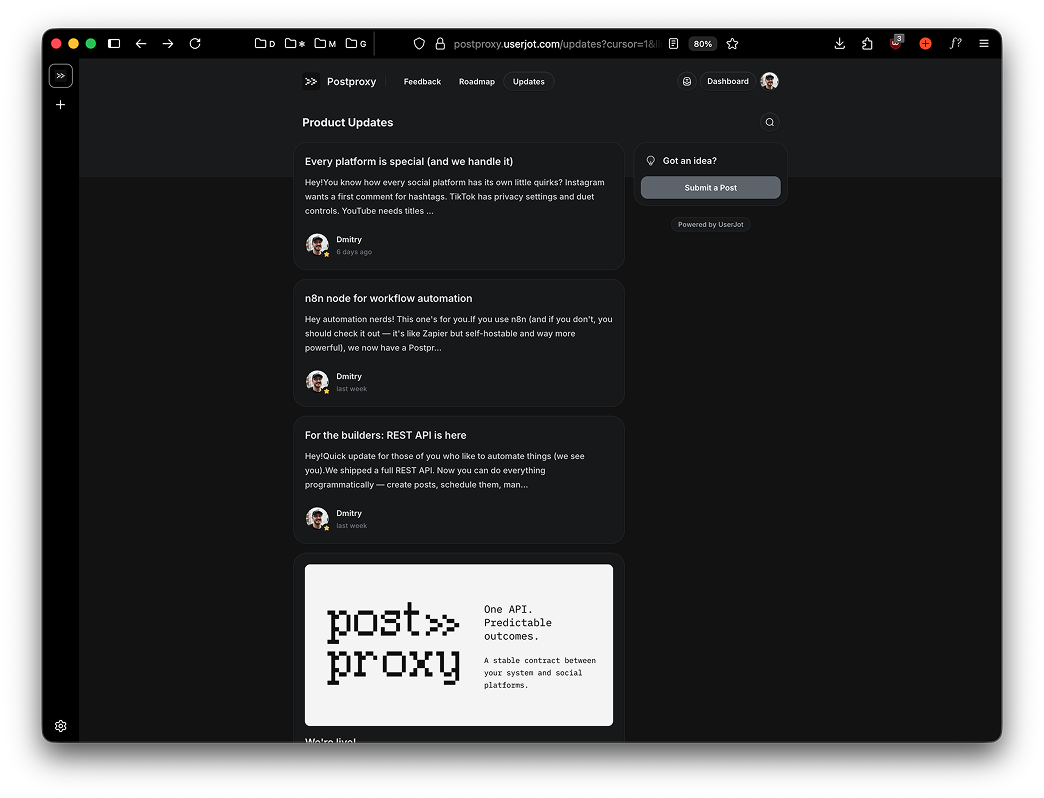
That is why we set up a public space for Postproxy updates, plans, and feedback at https://postproxy.userjot.com.
It combines three things:
- a changelog that reflects what actually shipped
- a roadmap that shows current direction without pretending to predict the future
- a feedback area where users can tell us what matters to them, in the open
None of these are new ideas on their own. What matters is having them in one place, connected.
Visibility is a product feature
For infrastructure products, visibility is not a nice-to-have. It is part of the contract.
If you are going to rely on a system, you need to see how it moves. What changes. What stays stable. What is being questioned. What is being ignored.
Making that visible is not about transparency as a value statement. It is about reducing ambiguity.
An open loop
This setup does not make Postproxy “finished”. If anything, it does the opposite. It keeps decisions open a little longer. It invites disagreement. It makes tradeoffs easier to see from the outside.
That is intentional.
Products do not become reliable by hiding change. They become reliable by making change understandable.
This is our way of doing that.
Postproxy
One API for every social platform
Publish to Instagram, X, LinkedIn, TikTok, YouTube and more with a single request. Free plan, no credit card required.