Why we started with an n8n node
Why Postproxy integrations came first, and why publishing only makes sense inside workflows.
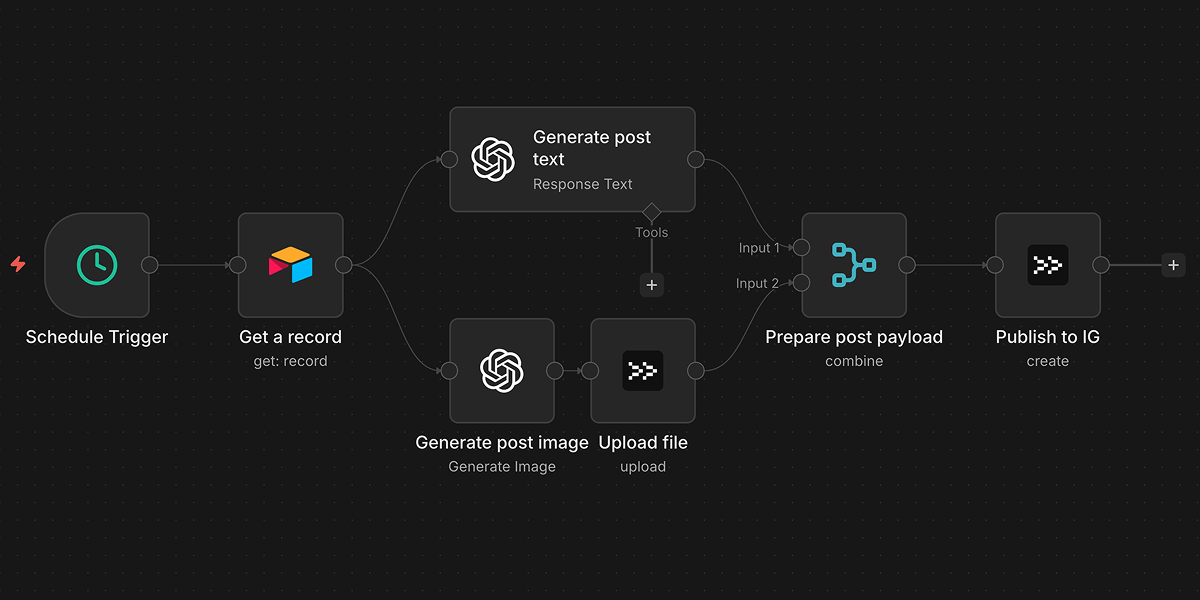
Postproxy was always meant to live inside workflows
Postproxy was never designed as a standalone social media tool. From the beginning, it was meant to sit inside larger systems, acting as a boundary between content production and platform execution. Publishing is not something people do in isolation. It happens as part of a flow, triggered by events, data changes, schedules, or automated decisions.
In the previous post, we described publishing as an operational problem. Operational problems don’t live in APIs or dashboards. They live between steps. That immediately raises a question: if Postproxy is a boundary, where should that boundary be exposed?
The answer was obvious to us early on. Inside workflows.
Where publishing actually breaks
In real systems, publishing is rarely a manual action. It is almost always downstream from something else. A new article appears in an RSS feed. A row is added in Airtable. A campaign status changes in a CMS. An AI system finishes generating content. Publishing is the last step, not the first.
That last step is also where things tend to break. Rate limits, partial failures, delayed errors, silent drops. These issues don’t show up clearly in SDKs or UI tools. They show up when you try to automate the entire path from input to outcome.
If Postproxy was going to be useful, it had to prove itself exactly there.
Why n8n was an obvious first choice
We didn’t start with an n8n node because it was a convenient marketing channel. We started with it because n8n makes workflows explicit. You see each step. You see where data comes from and where it goes. You see failures as part of a chain, not as isolated events.
That clarity is essential when dealing with publishing. n8n forces you to think in terms of intent, execution, and outcomes. It makes it very hard to hide complexity behind a single “success” flag. That aligned perfectly with how we think about publishing.
n8n also represents a class of users we care deeply about: people building real automation, not demos. People who connect systems together and expect them to run unattended. If Postproxy worked well there, we knew we were on the right track.
What we deliberately built into the node
The goal of the n8n node was not to expose every possible API detail. It was to express the right abstractions.
We made publishing a single node, not a branching tree per platform. We introduced profile groups so workflows could target logical sets of accounts instead of hardcoded IDs. Scheduling lives inside the publish intent, not as external cron logic. Most importantly, the node returns per-account outcomes, not a generic success response.
These choices were intentional. They reflect how publishing actually behaves in production. Partial success is normal. Delays are normal. Observability matters more than optimistic responses.
The node doesn’t try to be clever. It tries to be honest.
Why we built this earlier than most teams would
Many teams treat integrations as a final step. First you build the core product, then you add connectors once things feel stable. We did the opposite.
We built the n8n integration early because we wanted to stress-test our assumptions. Could Postproxy be understood without a UI? Could it be useful without documentation-heavy onboarding? Would its mental model hold up when embedded into real automation?
Workflows are unforgiving. If an abstraction is leaky, it becomes obvious immediately. Building the n8n node forced us to confront edge cases early and design Postproxy as infrastructure, not as a feature.
This is not “the n8n integration”
The n8n node is not a special case. It is the first expression of how Postproxy is meant to be used. Publishing is a boundary, and boundaries show up wherever systems are connected.
n8n happens to be a great place to make that visible. It won’t be the last. As long as people build workflows that end in “publish this”, there is a place for Postproxy to sit in between intent and execution.
That is why we started here.
Postproxy
One API for every social platform
Publish to Instagram, X, LinkedIn, TikTok, YouTube and more with a single request. Free plan, no credit card required.