No computers, please
Why publishing shouldn’t require staring at a screen — and why systems should do it for you.
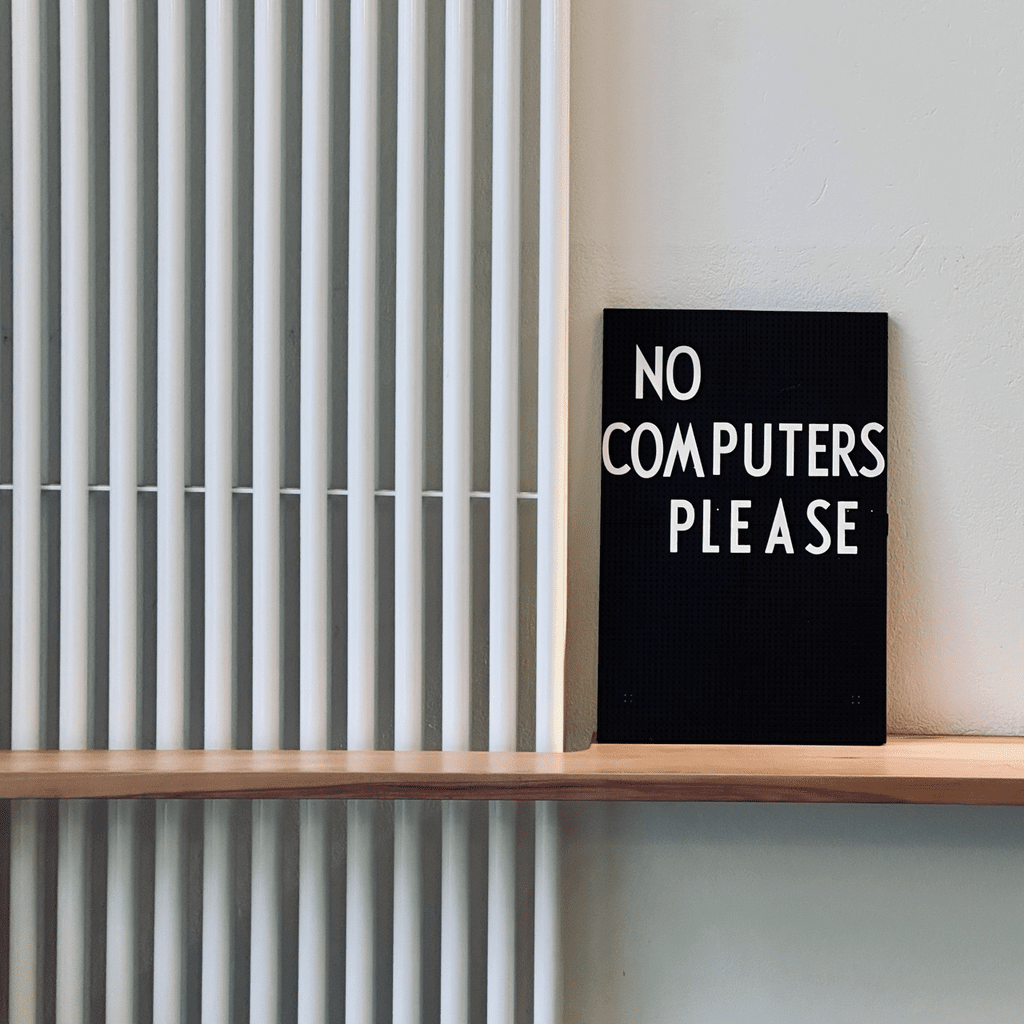
A sign in a coffee shop
I saw this sign today in a coffee shop: “No computers, please.”
It wasn’t aggressive. Not ironic. Just a quiet reminder that not everything needs a screen, a cursor, or a person sitting in front of a laptop. You order coffee, you talk, you think. Things still happen.
For some reason, it stuck with me. Probably because we spend a lot of time thinking about systems that still expect someone to be there, watching them work.
Why publishing still assumes a person
In many content systems, publishing is the last manual step left. Content is generated automatically. Data flows through pipelines. Decisions are made by software. And then, at the very end, someone is expected to open a tool and click “Publish”.
This is so common that it often goes unquestioned. Of course publishing needs a computer. Of course someone has to press the button.
But once you start building automated systems, that assumption begins to feel strange.
Systems don’t need screens
If a system can decide what should be published, it shouldn’t require a human sitting in front of a screen to finish the job. That requirement doesn’t add safety or quality. It just adds coupling to availability, attention, and timing.
Automation breaks not because systems fail to generate content, but because execution depends on someone being present. Someone noticing. Someone remembering.
That is not a failure of discipline. It is a design choice.
Publishing as execution, not interaction
When publishing is treated as an interaction, it needs interfaces, dashboards, and confirmations. When it is treated as execution, it needs contracts, retries, and observable outcomes.
Automated systems don’t need better buttons. They need publishing to be something that happens reliably, without supervision, as part of a flow.
That doesn’t mean removing humans from the loop entirely. It means removing the assumption that a human must always be there for things to move forward.
Let systems do the staring
The point of automation is not to make people faster at clicking. It is to let systems carry intent all the way through to impact.
You shouldn’t have to sit and stare at a computer to make sure your content goes out. Systems should handle that. Quietly. Reliably. Even when no one is watching.
Postproxy exists to help with exactly that last step. Not to generate content, and not to decide what should be published, but to make sure that when a system decides to publish something, it actually happens.
So you can look up from the screen. Or close the laptop. Or sit in a coffee shop where computers aren’t welcome.
Postproxy
One API for every social platform
Publish to Instagram, X, LinkedIn, TikTok, YouTube and more with a single request. Free plan, no credit card required.